Wednesday, September 25, 2024
Wednesday, August 21, 2024
Thursday, June 29, 2023
Southern New England Train
Sharing them here:
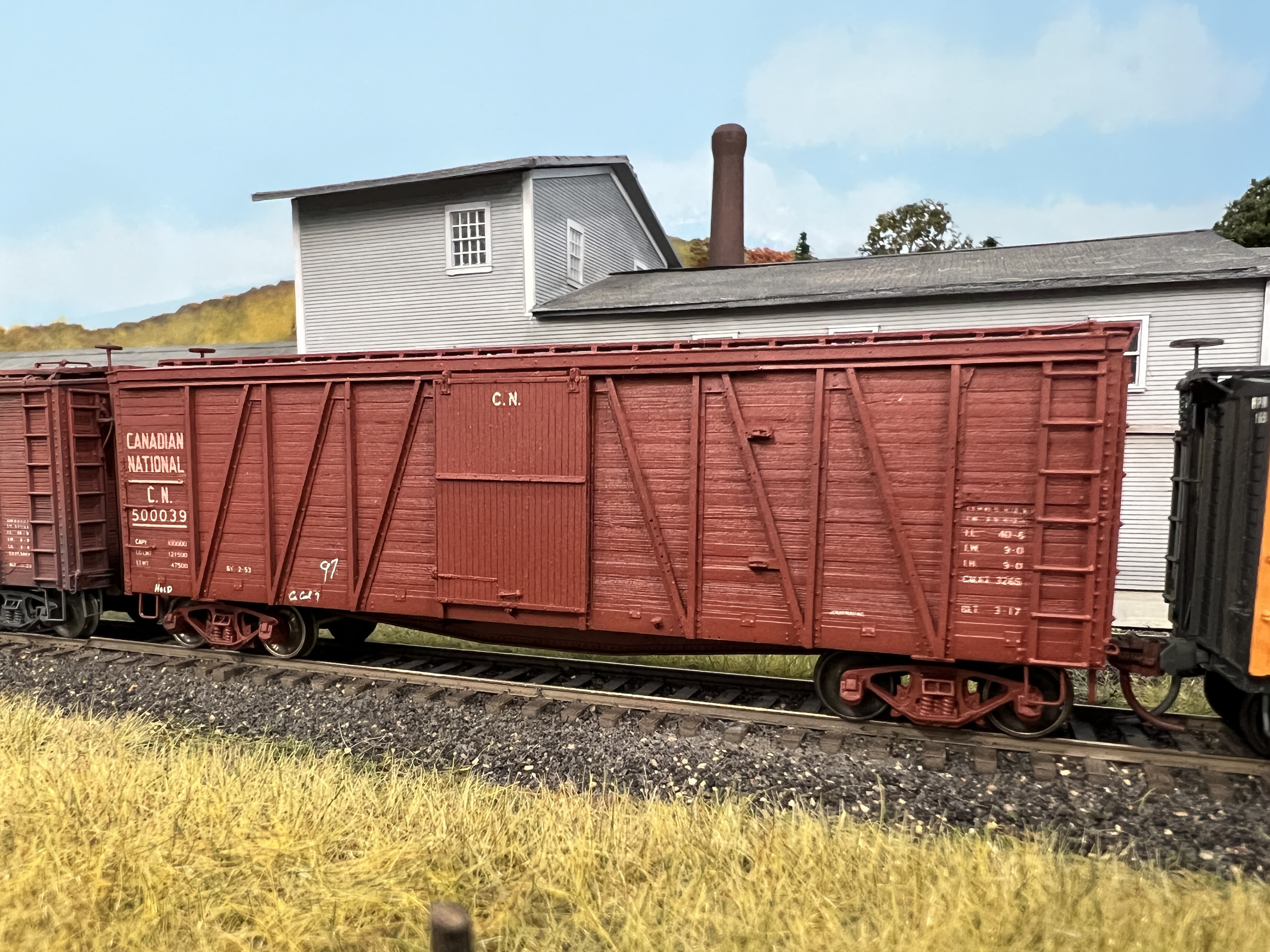
The first two cars are from a special run of PS-1s Kadee did a few years ago. In both the older square herald scheme (above) and the maple leaf scheme (below). There was a LOT of debate on my old SNE Yahoo (now Groups.io) mailing list about which scheme was the most appropriate. Personally I prefer the square herald since it doesn't read like a CN car. But I sent the North Shore club (that actually commissioned and sold the cars) both sets of art work. Perhaps they couldn't decide and went with both?!!The next three cars show how most of the SNE cars are decorated ("decorated" may be too fancy a term!) in accordance with Central Vermont practices. Cars are one color - CN Red #11, with plain white lettering. All three of these (Accurail) cars (the gondola, hopper, and single sheathed boxcar) are painted the same color. In fact I painted them at the same time. Guess I really need to weather that single sheathed boxcar!
Wednesday, April 5, 2023
Sunday, February 26, 2023
Bill Welch Freight Cars
Ted Culotta is handling the late Bill Welch's modeling estate. So when I saw Ted at Timonium a few weeks ago I was thrilled when he presented me with two of Bill's completed models. They're shown here posed on the Richford Branch. Note like most of Bill's models I've seen these two are beautifully modeled - and wear pristine paint jobs.
Currently these are in a display case alongside alongside other models from friends who have passed away - including Andy Sperandeo, Richard Hendrickson, Jack Ozanich, and Dick Elwell. I'm more than a little torn - should I weather these and run them as part of the operating fleet, or leave them as Bill built them?
Wednesday, February 8, 2023
Thursday, February 2, 2023
Riding the Head End
I was organizing and scanning some photos when I came across this favorite (click on photo to enlarge) that I obtained from Bob's Photos years ago.
CV 2-8-0 #472 is working this local between Palmer and Monson, Mass. on a sunny March 12, 1955.
What better place for the head end brakeman to keep an eye on things that atop the coal load in the first hopper? (A D&H car for those interested in such things).
Thursday, August 18, 2022
Enosburg Falls Condensery
I don't think I'll be able to get an actual model of the Enosburg Falls condensery before the MARPM Open House (before the end of the year is more likely!) but that doesn't mean I don't want to think through what the building might look like.
Here's a couple of views of the same side of the building (obviously the trackside of the building) from two different eras.
Obviously the building has seem some changes - I'd like to be able to determine the era these photos were taken - it may help refine what my model for the ~1941 era model should look like.
The shot with the GTW reefer is the later image of these two. I think the car barely visible to the extreme left is a showing the large "wiggle worm" CV logo of the post-1963 era.
The two freight cars in the earlier picture should be able to help set a baseline to come up with a range of years for that photo. I suspect it's sometime in the first 30 years of the 20th century but would like to narrow down the date.
Saturday, July 2, 2022
Pulpwood delivery - Sheldon Springs
![]() |
| Jack Delano photo, Sheldon Springs, Vermont, Sept. 1941 |
I've been doing some additional research on the Missisquoi Pulp & Paper complex at Sheldon Springs. I've featured the mill complex in previous posts HERE and HERE.
I'd gotten as far as laying the track and wiring it on my freelanced ("inspired by") version of the mill. But I've learned enough about the prototype over the last couple of years that my version simply isn't cutting it. The result has is a complete scrapping - down to the open grid benchwork - of my initial attempt.
I'll share more about how this is shaping up in future blog posts.
In the meantime I wanted to share this Jack Delano photo (above) from the Library of Congress website.
This is obviously a second pulpwood handling station (a photo of the other one appeared in a Wordless Wednesday post HERE).
![]() |
| The sign next to the shed reads "Engines Must Not Pass This Point". |
Obviously I plan to include some version of this wood unloading station on my revised mill. But this photo actually makes me ask more questions than it answers.
For example, while the wood is obviously being delivered by boxcars (not surprising) I'm a little puzzled by the fact that pulp logs appear to have been debarked. The pulpwood pile is on the other side of the plant from the pulp mill itself - so how did the logs get from the pile to the mill proper?
By the way the reporting marks on the end of the boxcar are CN 511534, making this a member of a very large group of CN single sheathed boxcars. Sylvan and Steam Shack (F&C) both offered resin kits for these cars.
There's clearly an NY&OW gon in the photo linked above. Perhaps that is an ex-NYO&W gon that's being used to shuttle the pulpwood within the plant complex?
Luckily none of these questions need to be answered before I get the basic benchwork, track, and wiring complete in the mill complex.
And yes, that little speck in the lead photo atop the pulpwood pile is indeed an OSHA violation waiting to happen.... <g>!
Wednesday, June 29, 2022
Wednesday, March 9, 2022
Wednesday, February 23, 2022
Saturday, February 19, 2022
Central Vermont Drop Bottom Gondolas
| CV drop bottom gon 4462. |
This time, our subject is perhaps the least documented of Central Vermont's roster, the four “drop bottom” gondolas. I know they existed since they appear on the CV Freight Car Classification sheets, although they apparently were never used in revenue service as they didn't appear in the ORER.
They tend to stay hidden in plain sight until you know what you're looking for - then they really jump out at you! Since they were assigned to cinder service they tend to appear in locomotive servicing areas such as New London, White River Junction, and St. Albans. I first noticed the end of one in a photo of New London.
| The end of the one of these gons is clearly visible on the New London cinder track |
According to a CV Freight Car Classification Sheet, these cars were built by Pressed Steel in 1923. They were 42'-11" long, with a width of 10'-3-1/2" and a height of 9'-1". The car classification sheet makes it seem as if all four were identical, although the capacity ranged between 44,900 and 47,200. Although they were built in 1923, I suspect the CV got them later than that – possibly acquiring them from another railroad.
Adding to the confusion about these cars, the ones in the Classification Sheets show they were numbered 4463-4469 (obviously not consecutively!). I was thrilled to find the relatively clear side view of these cars. But note the numbers on the cars shown here. Of course, these photos date from 1951 and 1953, so perhaps the cars were renumbered at some point. But if so, why?
| Also at New London |
Although I don’t know much about the early history of the cars the few photos that have come to light show enough details to allow a reasonably accurate model (see the photos in this post). They were equipped with drop bottom doors, as evidence by the actuating rod for the door along the bottom of the sides. The cars had flat steel plate ends with one or two ribs.
I haven’t seen any photos showing these cars in the pre-World War II Roman lettering (of course, if they arrived on the railroad later they may never have been painted in the Roman lettering). Sometime during the war years they would have been repainted in the then-standard “stacked” Gothic lettering with the Central Vermont roadname spelled out. During the late steam era the cars were painted standard Mineral Red (CN Red #11 from Scalecoat or Modelflex is a good match for this color). As they were used in cinder service, these cars tended to weather heavily.
Modeling Notes
My current layout doesn't have an engine servicing terminal, so I don't really need one of these cars but I'd still like to build one simply for the conversation value. I plan to use a Details Associates drop-bottom gondola kit as a starting point, although the Red Caboose (now Intermountain) GS gon may offer a better starting point. I actually have one of each in kit form in the stash! Detail Associates even offers an end (6222) that looks very close to those on the prototype. I will do a detailed post on the model when its complete.
This post is hardly a definitive history on these cars. I'm posting what I have now in the hope of unearthing some more details on these cars. If any readers have any info on these cars please share in the comment section!
Wednesday, February 9, 2022
Thursday, February 18, 2021
L&N Rebuilt Boxcar
Yet another half started freight car project that I've dug out of the box and completed. This is a Sunshine Models L&N rebuilt boxcar with Murphy ends, Sunshine Kit #64.11. I likely replaced the bracket grabs, ladder, and brake wheel that came in the kit with other after market parts. I did use some bits and pieces of Speedwitch's L&N boxcar decals (which are not specifically made for this car) to complement the kit decals. The carman's chalk marks are a combination of various Sunshine decals. It obviously still needs a little running weathering. That's the basic description of thing, but there's really a little more background to why I built this particular car.
Back when Sunshine Models hosted the Naperville RPM meets, Martin Lofton, the owner of Sunshine Models, often asked me to do an ongoing hands-on display showing people how to build these resin cars.. One "perk" for doing this was I'd often get early access to the coveted Sunshine "sale room" room before it opened for the other attendees. In this case he'd sent me the kit before the meet so I could get some of the basic assembly work done beforehand. I'm not sure I would have chosen this car on my own, since I haven't seen an L&N boxcar, let alone a pre war rebuild, in a photo on my prototype.
What really pushed this one to the top of the "finish it" pile was the passing of my good friend Bill Welch. Bill's first modeling love was the railroads of the Southeastern U. S., which he often called "Y'All Railroads." I'd gotten to know him on the prototype modeling "circuit" - and always appreciated a chance to visit with him. When I moved to the DC area Bill still lived here, and he organized several informal prototype modeling "show and tell" get togethers. Very small, very informal, and great fun.
Bill had sent me an email in late 2019 asking for my help in designing a small switching layout. We went back and forth on that a few times, and then several months passed. It was sometime last summer he wrote to tell me of his cancer diagnosis. By November he was gone.
I realize it's been a few months since Bill passed away, but I figured what better tribute to a friend than to finally finish up this Y'all road boxcar.
It seemed doubly appropriate since the very last email I received from Bill was a response to my question - "What color should I paint this thing?"
He recommended Badger's Light Tuscan Oxide Red. I don't really like Badger's paints after some truly miserable experiences with them early on. But Bill seemed adamant about this brand and color so that's the paint I used.
Perhaps they've improved the paint somehow?
Or perhaps Bill was looking over my shoulder?
In any event, if you don't like the model take it up with me. But if you don't like the color, you'll have to discuss that with Bill.
Saturday, December 5, 2020
Richford Branch Extra - Coming and Going - and notes on a side trip to Maine
This pair of Stan Bolton images, that I am sharing courtesy of Stan's good friend George Corey, show a pair of Central Vermont Consolidations (#s 465 and 466) working the daily local through Sheldon Junction, Vt., on an obviously "chilly" February 23, 1957.
A few of the cars are fairly easy to identify (click on the image to enlarge).
I'll go first - the lead car in the second image is a Central Vermont 40,000-series boxcar. Typically one of these cars was used to handle LCL on the Richford job.
A side note:
Almost exactly two years to the day before this image was taken, no. 466 and her sister no. 471 were both sent to the Grand Trunk (NEL). No. 466 made exactly one trip - actually less than one trip - when she experienced mechanical problems on an Island Pond to Portland, ME extra and was promptly returned to the CV.
No 471 faired much better than her sister on her assignment to Maine. She remained on the GT (NEL) through the end of August 1955 where she made 24 mainline trips, primarily on wayfreights. She even made a half dozen or so trips hauling passenger train no. 16, and spent 36 days as the Lewiston branch engine.
Obviously the St. Albans shop crew fixed whatever ailed no. 466 and she's steaming pretty well in these shots.
Wednesday, November 4, 2020
Thursday, August 22, 2019
Monday, August 19, 2019
CV 41000-series Boxcars - Some notes for modelers
Considering their relatively small numbers, these cars seem to come up on the Steam Era Freight Car List with surprising regularity. They reared their heads again a week or so ago on that list. My response with a couple of tidbits about modeling these cars may help you with your models of these cars.
These cars were in service for a very long time – through the late 1960s, but they really didn’t change in appearance all that much over the decades.
For perhaps more detail than anyone wants on these cars, I’d refer you to the following:
- Ed Beaudette did an article in MR (August 2001 I recall) that included prototype drawings of the CV/GTW 1-1/2 door as built cars (CV's 41000-series).
- There were a set of drawings in Mainline Modeler sometime in the late 1980s – they were listed as GTW cars, with no mention of the Central Vermont.
- The best reference for these cars is Steve Horsley’s article (which is part of an outstanding ongoing series on CV freight cars) in Volume 24, Issue #4 f the CVRHS “Ambassador.” I’d highly recommend checking that issue out.
- The end door casting kind of just hangs above the roofline and doesn’t really capture the beefy look of the prototype on the B end of the car. See this photo of the door end, and compare with the F&C model to see what I mean:
- My F&C kits (like me, they’re old!) came with regular ladders – some of the newer F&C kits come with Tichy “Canadian” ladders – neither of these are correct. The CV cars had an integrated sill step (basically the “stirrup” is welded to the ladder stiles, not the car side), but the shape of the step on the Tichy ladder isn’t correct.
- Compare the side ladder and stirrup in this photo of a 44000 series car with the Tichy part to see what I mean:
- The cars had wood running boards through most of their service lives. It’s possible a few of them may have received steel running boards, but I’ve never seen any photo evidence of such. I have seen some of these cars with steel brake platforms.
One issue that always comes up when discussing modeling these cars are the trucks.
The cars rode on cast steel ARA U-section trucks with spring planks and Barber lateral motion bolsters equipped with six springs per side frame--a style called "increased spring capacity trucks" by several manufacturers.
The MR article referenced above states the ECW 9074 70-ton "Bettendorf" trucks are closest. That’s a typo – it should be 9064 (I started editing the article, but had left the MR staff before it was published and a couple of minor, but annoying errors crept into the copy.) I got the reference to those trucks after extensive back and forth with Richard Hendrickson – and while those ECW trucks might look the closest, I’ve never bothered using them, or even trying to find a set since the operating qualities of ECW trucks are marginal at best.
As a side note, my first item published in a “real” model railroad magazine was a review of this kit (at the same marketed by Steam Shack but produced by Steve Funaro). Just for fun, here’s a photo of that model – warts and all - including its completely incorrect Kadee "Bettendorf" trucks! - on Paul Dolkos’ former B&M White Mountain Division: