Showing posts with label Steam Locomotives. Show all posts

Monday, February 17, 2025

Video Update #14


 Just published a new layout update on YouTube - this one includes a closer look at a new addition to the junction area, discusses future plans for that section of the layout, and includes some video we shot test running the newly released Broadway Limited B&M 2-8-4. I was so impressed with that model I think we'll be adding one to the SNE's roster!

You can find the video here:

https://youtu.be/pfm3Z6blNtw


Wednesday, March 29, 2023

Saturday, February 12, 2022

New Life for an Iron Horse


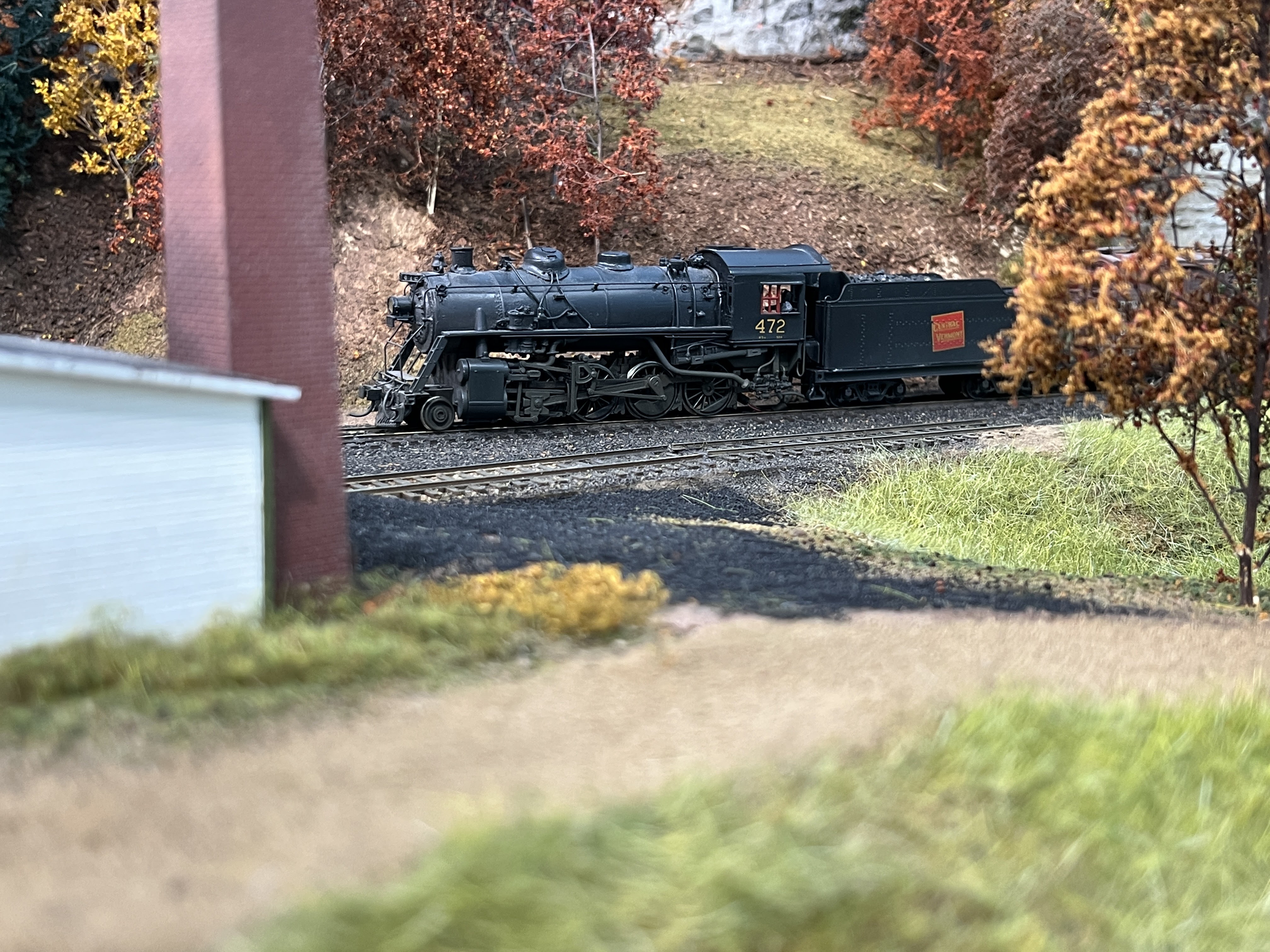
Central Vermont 2-8-0 no. 472 is back in service after seven years sitting in a box! 
I mentioned one of my goals for this weekend was to get CV no. 472 back into service. 

This is an extensively detailed Bachmann Spectrum 2-8-0. It's actually a very, very early example of the model since it was the Model Railroader review sample. After Andy Sperandeo finished reviewing it he gave it to me 

This is how the locomotive looked immediately after being pulled out of storage. 
Iain Rice happened to be visiting Wisconsin at the time and I showed him the model and the drawings of the CV locomotive. We looked it over and noted the wheelbase and overall dimensions were pretty close to a CV N-5-a class engine. Iain mentioned it shouldn't be too difficult to get pretty close to a CV 2-8-0 starting with the Bachmann model. Not one to look a gift horse in the mouth, I sent him back to England with the locomotive and a shoebox full of Cal-Scale, Kemptron and Bowser detail parts. 

I think the project was a little more involved than Iain bargained for - the photos here of the unpainted model show just how many details he added, moved, and removed, but it is remarkable how close it looks like a CV 2-8-0. 

Views of the front and rear half of the locomotive show just how much rework and redetailing Iain Rice did to get this engine to capture the look of the CV prototypes. 

During the several months Iain was working on the engine another exciting new product arrived - a Soundtraxx DCC steam sound decoder. After the locomotive arrived back in the U. S., I installed the Soundtraxx decoder before painting, decaling and weathering the locomotive. 

The original Soundtraxx decoder 

Number 472 was in regular service on both the first and second versions of my Southern New England. In 2015 I was getting ready for an op session when I noticed 472 was just not sounding or working right. I even mentioned it in this blog post

She was "stored, awaiting disposition" for the next few years while other projects took priority. 

A few weeks ago I dug the engine out the box and put it on the track. Not surprising the poor performance hadn't gone away with age. But I decided to swap out the old decoder and speaker. The nine-pin connectors made the actual decoder swap a simple matter. Swapping out the speaker was a little trickier, mostly because of the custom made baffle that I ended up having to remove to fit the new speaker in place.

I also took the time to dust the locomotive and tender off, and to clean the wheels and the copper pickup tabs on the engine and tender.  

I'm pleased to report that 472 is back in service, looking and sounding better than ever!


Tuesday, November 9, 2021

Pre-WWII steam lettering color - another data point?


One of my long dormant projects that's at last getting off the "to-do" list is to detail, paint and letter a couple of steam locomotives in the "pre-WWII" style of lettering. I've blogged on this topic several times - see this POST  for some background information. 

Matthieu Lachance did some artwork for this longer ago than I care to admit - the post showing what his artwork looked like can be found in THIS 2020 post. 

The one fairly significant piece of the puzzle I don't have a definitive answer to is what color the lettering was. 

We do know, based on the well-researched Canadian National Steam by Donald McQueen that in 1912 the standard color for steam locomotives was black with numerals and lettering in "standard golden yellow." But in 1919 that was changed for the CNR and GTW to "white or aluminum 12-inch block lettering (gothic) stencilled onto the tender sides.  But when Matthieu and I were researching the lettering we found one - that's exactly one - CV locomotive with the Gothic block lettering. All the rest of the CV locomotives retained their serif style lettering in one form or another through WWII. 

McQueen offers some details on CV lettering without any comments on the color in the CV roster volume of his amazingly in-depth series. Some notes that may prove helpful to blog readers:

1. Pre-1895 or so CV used two styles of tender lettering. The "undulating spelled out road name" was primarily used on leased system engines, such as the O&LC, New London Northern, and Rutland. The "CVRR" initials were primarily used on "home road" engines. Locomotives painted in those schemes we know were delivered from the factory with gold lettering. 

2. In 1899 the GTR assumed control of the CV, and instituted a locomotive renumbering. The "standard" paint scheme at this time became the lettering in the photo of no. 395. In 1917 the striping around the side of the tender disappeared. Shortly after, the road name on the tender also disappeared. 

3. Between 1923 and 1927 the only change to the CV lettering was the addition of haulage rating (as a percent) centered under the road name on the side of the cab. The white outlined "Central Vermont" box monogram on the side of the tender first appeared with the delivery of the 2-10-4s in 1928.  

All of this begs the question if the CV didn't change its locomotive paint scheme in 1919 to keep pace with the new GTR system standard - AND the lettering was "standard golden yellow" IS IT possible the CV retained the yellow lettering? 

It's possible, but I don't think it's likely. 

Recently I stumbled across a couple of web sites that will colorize black and white photos - and while I don't think they're perfect - actually far from it - I thought it wouldn't hurt anything if I uploaded several of the photos I have of pre-WWII CV engines and see what color they think the lettering was. 

The results were interesting, to say the least. I've included a photo of 2-8-0 395 in both the monotone and colorized version. 

I'm not going to upload the other dozen or so photos I colorized (for the record I tried three different online services - the one shown here is from a site called "MyHeritage.")  I found the photos were all somewhat faded. 

Notice the lettering under the cab windows has a slight - but very definite - overall yellow tone. And so does the tender lettering. However, careful study of the right side of the "9" on the tender seem to show the lettering is may have been some sort of white, light gray, or perhaps something similar to aluminum paste. 

I'm not sure what the answer is, but since the CV didn't change their lettering style in 1919 with the rest of the GTR I think I have a pretty strong case for the golden yellow lettering. 

When I have the decals printed I think I'm going to go with both colors - but my personal preference is the yellow - I think it looks sharper! 


Friday, July 24, 2020

Color of Older Steam Locomotive Lettering


I've blogged about Central Vermont steam locomotive paint and lettering schemes prior to the familiar "tilted wafer" that became a Canadian National system wide standard in the 1930s. You can find that discussion here
A while back, Matthieu Lachance was kind enough to prepare the artwork for the CV steam locomotives in this era (there was an even earlier CV steam lettering style, shown below on 4-4-0 no. 100), but the style in the artwork and shown on no. 101 above dates to 1900, and lasted up through the mid 1930s with some variations.  
I've just about got the artwork arranged into number jungles that match some of the engines I might want to model someday. So I'm all set to get decals printed, Right? Wrong. 
I don't know what color the lettering was. 
My best guess is it was either some form of "white" - even a very light gray. I don't think it would have been aluminum paste lettering, like that found on Santa Fe locomotives up through the end of steam. 
Or the lettering was some version of yellow - "Deluxe Gold" - best described as "mustardy" yellow and applied to Pullman and other passenger cars starting in the early 20th century. 
I don't think it would have been gold leaf - which would appear like glittery gold lettering - since gold leaf was more expensive and likely went out of style about the same time locomotives lost their Russia Iron boilers jackets. 
Perhaps in-depth examination of the railroad's accounting records would reveal if, and when, they bought a particular stock of paint for the locomotive shops. Perhaps, but I simply don't have the resources or information to conduct such detailed research. 
Of course, it's also possible they did something like apply gold lettering to passenger engines, and white to freight hogs. 
I have reached out to some experts in the railroad's early history to see if they can offer any insight. Otherwise, I'll figure it's a best guess and press on. I know which way I'm leaning. I'm leaning towards some form of yellow lettering, , but that's wishful thinking based on the fact I think the locomotives would look sharp - but I have absolutely no evidence to support that choice. 
Come to think of it, I have no evidence to dispute it either!
Maybe I should have the decals printed up in both colors to hedge my bets? 

Monday, March 26, 2018

Finding virtual (and actual) stuff ...

N-5-a 463 on the Richford local, George Corey photo. 
Moving is ... well I was going to say "is an adventure" but frankly it just plain sucks....
But the weirdest part is the unboxing - it's like Christmas morning - especially when you find a few months have passed before you're reunited with your stuff. 
Of course there's a fair amount of "what did we save this for?" Followed by the amusement of discovering the movers carefully wrapped and boxed up everything - even the plastic knives and forks from the local fast food place that happened to be sitting on the kitchen counter on moving day!
Then there's this file folder of papers that I'm constantly loosing and finding again. I swear it has legs. In my case it's copies of three typewritten booklets listing the industries served by the CV.  I thought I'd included the folder in a small file box of reference material I brought to the apartment. Went to look for it a few weeks later only to spend most of a frustrating Sunday afternoon looking for them, concluding the folder must have gotten boxed up (maybe with the plastic knives and forks?). 
Of course yesterday I was emptying a few more boxes in the office, including that box of reference material I'd taken to the apartment. Sure enough, there was that stupid file folder with list of industries. It wouldn't be so bad except this isn't the first time this folder has gone rogue. It disappeared in the old house a couple of times. And I wouldn't be surprised if I went home tonight to find it's gone over the hill again.
In addition to the "analog" unpacking, there's also the fun of virtual unpacking. I'd packed up my large Mac desktop since there simply wasn't room for it in the apartment. Saturday I unpacked it, plugged it in, and turned it on for the first time in months. Thankfully, she fired right up - and I ran across several Richford branch photos George Corey had emailed me a few months back, including the one above. I think it nicely captures the spirit of the Richford Branch in the late steam era. 
It also reminded me I need to include a few wood pile trestles on the layout. 
And speaking of the layout, for ease of reference I've added a tab just below the header that should take you directly to the most current CV Richford Branch layout design. 

Sunday, November 26, 2017

Minimum Radius for Division Point 2-10-4?

As I was talking through the possibilities of a "mainline" layout design with Bernie Kempinski at lunch the other day I mentioned that one requirement of any mainline layout would be the ability to run this thing. This "thing" is a Central Vermont T-3-a class 2-10-4 imported by Division Point about a decade ago. 
I was so enamored with it that I sold my two "old school" PFM 2-10-4s. Yes, this model is more accurate than the PFM model, but honestly if I'd known how much of curve hog these engines were going to be I would have kept my PFM models and lived with the compromises. 
I was going to use the money  to purchase this model when my bride surprised me with one as an anniversary present. 
Since that day I occasionally get asked if I'm going to run my "nice" engine. 
When asked how it runs I also answer honestly - it runs great... in a straight line. 
Curves are a real challenge with this thing. 
A combination of flanged driving wheels, long wheelbase, outside frame on the trailing truck that has components tucked inside the ashpan, not to mention the full diaphragm between the locomotive and tender and you have a recipe for a curve hog of immense proportions. 
I've actually never been able to determine this things real minimum radius (the importer claimed something like 30" or some such!) - on the old layout it would almost get around a 34" radius curve - the drivers would normally lift about halfway through the curve and the trailing truck was truly hanging up. 
For the track plan we're sketching I'm assuming that 48" curves should work. I have place in the apartment to test the engine on a curved section of track.
 That all leads to the reason for this post - does anyone have experience getting one of these beasts successfully around a curve? 
And if so, what radius? 

Wednesday, June 14, 2017

Wordless Wednesday #157

CV 2-10-4 no. 707, north of Brattleboro, Vt. November 11, 1951, George Corey photo.